Which Compound to Use to Manufacture a Plastic Helmet Lock?
Use Unfilled Super Tough Compound (NEXXALON™ PA6) to manufacture a Plastic Helmet Lock.
- The super tough grade is formulated specifically for parts "where repeated hammering is involved" — its very high impact strength, excellent elasticity and elongation, and retained toughness at low temperature make it the right choice over standard or reinforced PA6 for a mechanism like a helmet lock.
- Helmet locks are injection molded from dried super tough PA6 pellets.
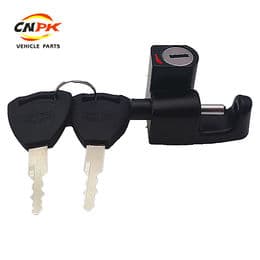
What Is It?
NEXXALON™ Unfilled Super Tough Compound is a PA6 grade modified for very high impact strength and elongation, retaining toughness down to -40°C rather than becoming brittle in cold conditions.
How It's Manufactured
An impact modifier is melt-blended into the PA6 base resin on a twin-screw extruder alongside heat stabilizers. The modifier forms a fine, well-dispersed rubber phase within the polyamide matrix — the compounding shear profile is tuned specifically to achieve this dispersion, since poor mixing here is what causes inconsistent impact performance batch to batch.
Manufacturing Process for This Application
Helmet locks are injection molded from dried super tough PA6 pellets. Because the mechanism is repeatedly snapped open and shut and occasionally dropped or struck, wall thickness and gate placement are designed to avoid stress concentration points where a less impact-resistant material would eventually crack.
Why Polymer Choice Matters Here
A standard unfilled PA6 or a glass-filled grade would be too brittle for a hinge or latch component subjected to repeated snap-impact loading — glass fiber in particular raises stiffness but lowers elongation-at-break, which is the wrong tradeoff for a part that needs to absorb repeated shock without fracturing.
Why This Compound Is Suited
The super tough grade is formulated specifically for parts "where repeated hammering is involved" — its very high impact strength, excellent elasticity and elongation, and retained toughness at low temperature make it the right choice over standard or reinforced PA6 for a mechanism like a helmet lock.
Nexxa Compounds is a leading manufacturer of PA6 compounds for helmet lock applications in India, supplying some of the largest manufacturers across India and internationally.
Frequently Asked Questions
What is Unfilled Super Tough Compound?
NEXXALON™ Unfilled Super Tough Compound is a PA6 grade modified for very high impact strength and elongation, retaining toughness down to -40°C rather than becoming brittle in cold conditions.
How is Unfilled Super Tough Compound manufactured?
An impact modifier is melt-blended into the PA6 base resin on a twin-screw extruder alongside heat stabilizers. The modifier forms a fine, well-dispersed rubber phase within the polyamide matrix — the compounding shear profile is tuned specifically to achieve this dispersion, since poor mixing here is what causes inconsistent impact performance batch to batch.
How is Helmet Lock produced from this compound?
Helmet locks are injection molded from dried super tough PA6 pellets. Because the mechanism is repeatedly snapped open and shut and occasionally dropped or struck, wall thickness and gate placement are designed to avoid stress concentration points where a less impact-resistant material would eventually crack.
Why does the choice of polymer matter for Helmet Lock?
A standard unfilled PA6 or a glass-filled grade would be too brittle for a hinge or latch component subjected to repeated snap-impact loading — glass fiber in particular raises stiffness but lowers elongation-at-break, which is the wrong tradeoff for a part that needs to absorb repeated shock without fracturing.
Where can I buy Unfilled Super Tough Compound in India?
Nexxa Compounds Pvt Ltd manufactures Unfilled Super Tough Compound at its Delhi and Haryana facilities and supplies manufacturers across India. Call +91 9582991105 or email info@nexxacompounds.com for samples, specifications and a quote.
Related Posts
Which Compound to Use to Manufacture a Vehicle Fuel Cap
Why glass-filled PA6 is the standard compound for automotive fuel caps, how it is manufactured, and which grades to consider as alternatives.
Which Compound to Use to Manufacture a Car Door Handle
Why unfilled PA6 is specified for exterior door handles, and when to step up to a reinforced grade instead.
Which Compound to Use to Manufacture a Lamp Housing
Why mineral-reinforced PA6 is a cost-effective choice for lamp and wheel-cover housings that need a good surface finish.